Would You Pay for Invoicing Software That Improves Workflow
Would you pay for invoicing software that fits your workflow? Learn when it is worth paying, what features matter, and how to choose the right tool.
A repair order and an invoice are not the same document, and the gap between them is where most auto repair shops lose money. A repair order captures the diagnostic findings, the parts ordered, the labour performed, and the technician notes. An invoice is the billing document the customer receives. In a shop running on QuickBooks or generic invoicing software, converting the repair order into an invoice means re-entering every line item, recalculating parts markup, and manually applying shop supplies and environmental fees. That process takes 10 to 20 minutes per vehicle and introduces errors that shrink margins.
Purpose-built auto repair shop management systems eliminate that gap by treating the repair order and the invoice as a single document in different states, with the invoice generated automatically from the completed RO data.

A mechanic at work. Auto repair invoicing differs fundamentally from general business billing because the invoice must capture vehicle-specific data (VIN, mileage, year/make/model), parts with markup, labour at flat-rate or time-and-materials, and shop supplies, all tied to a repair order that may span multiple days.
A repair shop invoice must carry information that generic billing platforms are not built to store. The minimum requirements are:
VIN decoding and vehicle history. The VIN identifies the exact vehicle and pre-populates year, make, model, and engine. Previous visit history for that VIN should appear automatically so the service advisor can reference prior work.
Flat-rate labour guide integration. Labour time is typically priced from a published flat-rate guide (Mitchell 1 ProDemand, Epicor, or Motor) rather than from actual time clocked. The guide provides the standard hours for each repair procedure; the shop applies its labour rate per hour to calculate the charge.
Parts markup matrix. A rule-based markup table applies different margin percentages to parts in different cost brackets. A $10 gasket might carry 50 percent markup; a $400 fuel pump might carry 25 percent. The matrix enforces consistent margin without requiring the service advisor to calculate each time.
Digital Vehicle Inspection (DVI). A photo and video inspection report shared with the customer via text link before the estimate is approved, converting more authorised repairs and reducing disputes at invoice time.
Automatic shop supplies and environmental fees. A percentage-based or fixed charge applied automatically to every invoice for consumables and fluid disposal. Shops that apply this manually miss it on a significant percentage of invoices.
Text-to-pay. A payment link sent by text message so customers can pay remotely, increasing after-hours collections and reducing wait time at checkout.
QuickBooks or Xero sync. Parts purchases, labour revenue, tax, and payments need to flow to the accounting system without re-entry.
Compare the best auto repair invoice software based on pricing, key features, and shop-specific use cases.
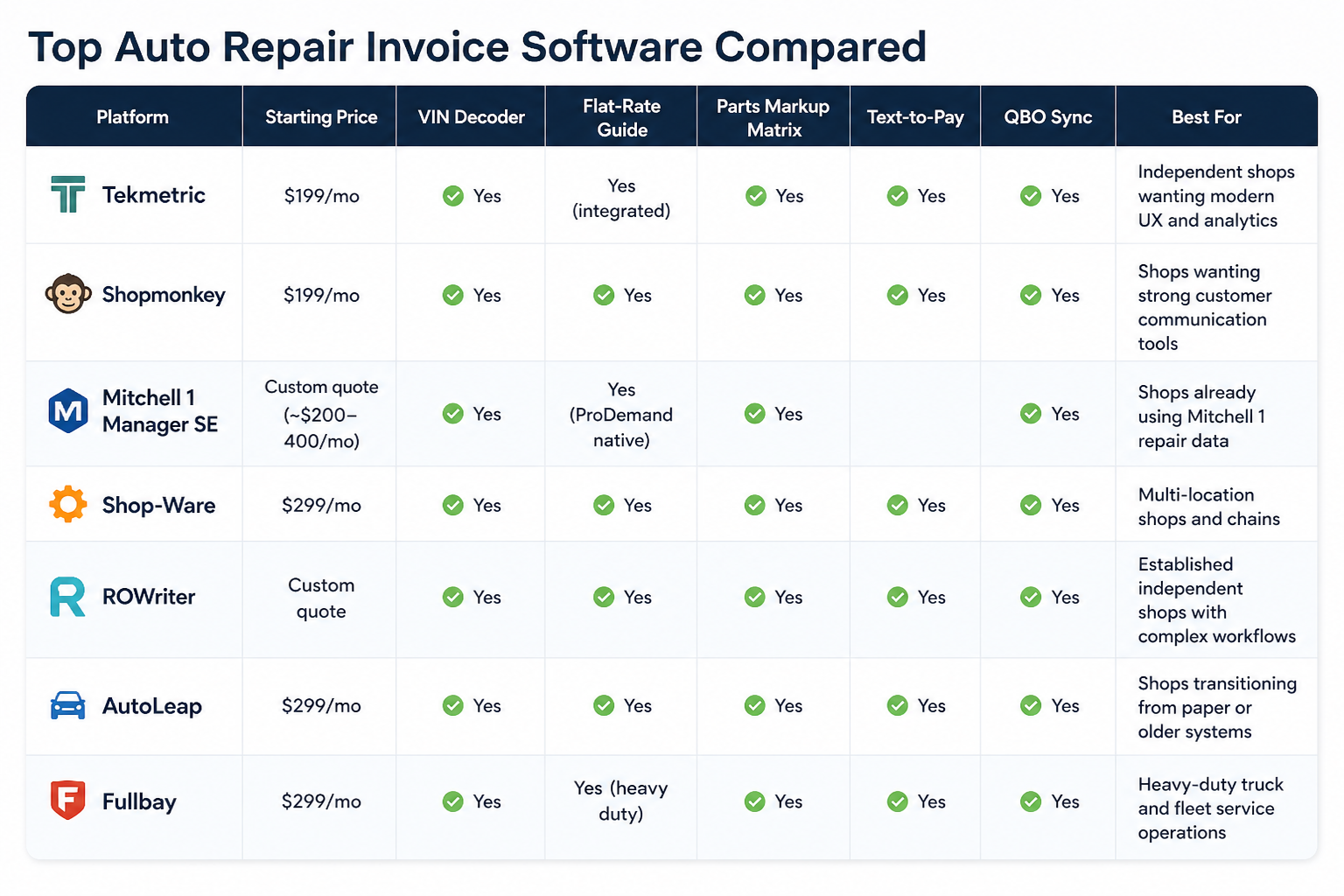
Platform | Starting Price | VIN Decoder | Flat-Rate Guide | Parts Markup Matrix | Text-to-Pay | QBO Sync | Best For |
Tekmetric | $199/mo | Yes | Yes (integrated) | Yes | Yes | Yes | Independent shops wanting modern UX and analytics |
Shopmonkey | $199/mo | Yes | Yes | Yes | Yes | Yes | Shops wanting strong customer communication tools |
Mitchell 1 Manager SE | Custom quote (~$200-400/mo) | Yes | Yes (ProDemand native) | Yes | Yes | Shops already using Mitchell 1 repair data | |
Shop-Ware | $299/mo | Yes | Yes | Yes | Yes | Yes | Multi-location shops and chains |
ROWriter | Custom quote | Yes | Yes | Yes | Yes | Yes | Established independent shops with complex workflows |
AutoLeap | $299/mo | Yes | Yes | Yes | Yes | Yes | Shops transitioning from paper or older systems |
Fullbay | $299/mo | Yes | Yes (heavy duty) | Yes | Yes | Yes | Heavy-duty truck and fleet service operations |
Use this comparison to choose the right invoicing software that fits your workflow, budget, and business needs.
Parts markup is the most contested aspect of an auto repair invoice. Shops typically mark up parts between 20 and 50 percent, depending on the cost bracket, because parts markup covers not just the part but the associated warranty, storage, return handling, and working capital cost. A customer comparing the shop's charge to an online retail price (which carries no labour, no warranty on installation, and no return handling) is making an incomplete comparison. The invoice software helps by clearly separating parts cost and labour cost on the invoice, which reduces disputes by giving the customer visibility rather than a single opaque total.
Invoice Section | What to Include | Common Error |
|---|---|---|
Vehicle information | VIN, year/make/model/engine, mileage in and out | Missing mileage causes warranty disputes |
Labour lines | Repair description, flat-rate hours, labour rate, total per operation | Bundled labour hides the rate and triggers price objections |
Parts lines | Part number, description, quantity, unit price, extended total | Missing part numbers make warranty claims harder to process |
Sublet | Any outsourced work (alignments, glass, machine shop) as a separate line | Buried sublet inflates apparent labour rate |
Shop supplies | Percentage-based fee for consumables (rags, cleaners, small hardware) | Not applied consistently, leaving 3-5% on the table |
Environmental/hazmat fees | Fixed or percentage fee for fluid disposal, battery recycling | Often forgotten on quick oil changes and battery replacements |
Tax | Correct rate for labour (often exempt) and parts (taxable in most states) | Applying one rate to everything creates tax liability |
A correctly structured auto repair invoice prevents customer disputes, captures consistent margin, and creates a clear audit trail for warranty claims. Shop management software enforces this structure automatically; generic invoicing tools require manual discipline that rarely holds under volume.
An official Tekmetric walkthrough covering the complete repair order-to-invoice workflow, including VIN decoding, parts ordering, DVI, and text-to-pay. Published by Tekmetric. Useful for shop owners evaluating Tekmetric against Shopmonkey or Shop-Ware.
QuickBooks can record transactions from an auto repair shop, but it cannot produce repair orders, decode VINs, integrate with flat-rate labor guides, or manage a digital vehicle inspection workflow. Most shops that use QuickBooks for accounting pair it with a dedicated shop management system (Tekmetric, Shopmonkey, Mitchell 1, or similar) and sync invoices to QuickBooks via integration. Running a busy shop entirely on QuickBooks without a dedicated SMS is possible but results in significant manual re-entry and margin leakage.
A flat-rate labor guide is a database of standard times for each vehicle repair operation, published by Mitchell 1 (ProDemand), Epicor, or Motor. For example, replacing front brake pads on a specific vehicle might carry a standard time of 1.2 hours. The shop charges 1.2 hours at its labor rate regardless of whether the actual job takes 45 minutes or 90 minutes. The guide creates pricing consistency and removes technician speed from the billing equation. Shop management software integrates directly with these guides; without integration, service advisors look up times manually and apply them inconsistently.
Many shops decline customer-supplied parts because they cannot warranty the installation if the part fails. Those that accept them commonly charge a higher labor rate to offset the lost parts margin, and they document on the invoice that no warranty applies to customer-supplied components. This policy should appear in the shop's terms and conditions and should be documented on every invoice where customer parts are installed.
Most purpose-built shop management platforms start at $199 to $299 per month for a single-location shop with one or two service advisors. Mitchell 1 Manager SE and ROWriter are typically quoted after a discovery call and commonly fall in the $200 to $400 per month range. Fullbay for heavy-duty shops starts at $299 per month. All platforms offer free trials or demos; most require an annual contract after the trial period.
Both are well-regarded modern platforms. Tekmetric is generally preferred by shops that want strong analytics and margin visibility; its reporting on effective labor rate, parts margin, and technician efficiency is the most detailed in the category. Shopmonkey is generally preferred for its customer communication tools: text message workflows, appointment reminders, and digital authorization flows. Shops that care most about customer experience tend toward Shopmonkey; shops that care most about profitability analytics tend toward Tekmetric.
Yes, most platforms support fleet accounts with purchase order numbers, consolidated billing by vehicle or by account, and payment terms (Net 30). Tekmetric, Shop-Ware, and Shopmonkey all include fleet account management. For operations where the majority of revenue comes from commercial fleets (municipal fleets, trucking companies, utility vehicles), Fullbay's heavy-duty focus includes fleet-specific features like DOT inspection tracking and preventive maintenance scheduling.
Would you pay for invoicing software that fits your workflow? Learn when it is worth paying, what features matter, and how to choose the right tool.
What do you use to manage invoices and track payments? Compare tools, features, and simple ways to stay organized with the right invoicing software.
Find the best free invoicing software for freelancers and small businesses. Compare features, limits, and tools to manage invoices, payments, and clients.
Looking for invoicing software recommendation? Compare top tools, features, pricing, and use cases to manage invoices, payments, and clients with ease.